Car Depreciation in the Philippines: 2026 Rates and Formula
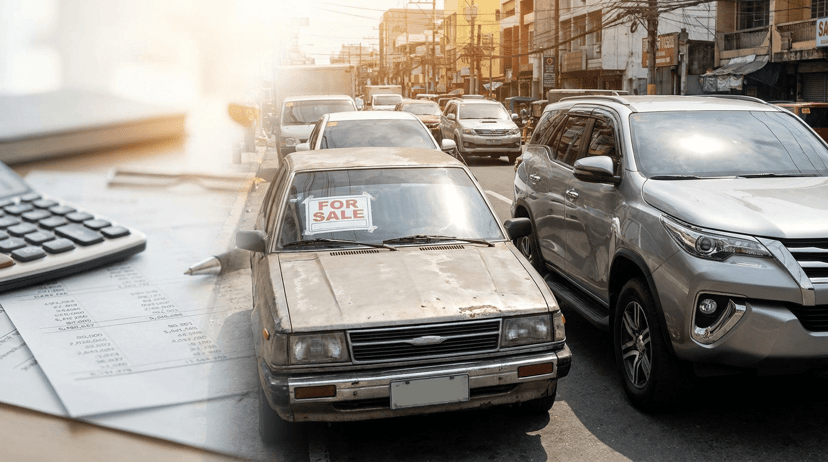 Car Depreciation in the Philippines: 2026 Rates and Formula
A car in the Philippines loses about 20% of its value in the first year and 10–15% of its remaining value each year after, so a ₱1,000,000 vehicle is worth roughly ₱578,000 to ₱648,000 by year three. Depreciation is the largest single cost of owning a car here.
Most owners only find out how much they have lost on the day they try to sell. By then the number is fixed, and the two or three decisions that would have protected it are years behind them.
Key Takeaways
Year one is the steepest drop: about 20%, and up to 25% on heavily used units.
Years two to five run 10–15% of remaining value per year, depending on the badge — Toyota, Honda, Mitsubishi and Nissan sit at the slow end.
By year five a car typically retains 42% to 53% of what you paid for it.
Year three is the common sweet spot to sell — around 42% of value gone, but before the year-four maintenance bills land.
If the car is in a company name, the BIR caps depreciation at ₱2,400,000 per vehicle and one vehicle per official under RR 12-2012, effective 17 October 2012.
What Car Depreciation Actually Means Here
Depreciation is the gap between what you paid and what a buyer will pay today. It is not a fee anyone charges you. It accrues quietly from the moment the unit leaves the dealership and only becomes real cash when you sell, trade in or total the vehicle.
In the Philippine market it is driven by badge more than by anything else. Two cars of the same age and mileage can sit ₱100,000 apart purely on how a Filipino buyer reads the nameplate and the parts supply behind it.
It is also the cost owners are least able to see. Fuel and registration arrive as receipts; depreciation arrives once, as a lower offer. The Motorist App exists partly to make it visible earlier — checking your valuation while you still own the car turns a surprise into a decision.
How Fast Cars Lose Value: The Year-by-Year Numbers
Take a ₱1,000,000 vehicle bought new, on the faster curve — 20% in year one, then 15% of remaining value each year:
End of year 1: ₱800,000 — 20% gone
End of year 2: ₱680,000 — 32% gone
End of year 3: ₱578,000 — 42% gone
End of year 4: ₱491,300 — 51% gone
End of year 5: ₱417,605 — 58% gone
The same ₱1,000,000 vehicle on the slower curve — 20% in year one, then 10% a year, which is where the strongest-holding Japanese models sit:
End of year 1: ₱800,000
End of year 3: ₱648,000 — 35% gone
End of year 5: ₱524,880 — 47% gone
The spread is the point. Over five years the badge alone is worth about ₱107,000 on a ₱1,000,000 purchase. That gap is decided the day you buy, not the day you sell.
The Fast Curve vs the Slow Curve
Japanese nameplates hold value best in the Philippines — Toyota, Honda, Mitsubishi and Nissan — on reliability reputation and parts availability in the provinces.
Korean brands sit in the middle. Hyundai and Kia have closed much of the gap on quality perception but still trail on resale demand.
European and American units depreciate fastest here, largely on parts cost and the thinner network of independent shops willing to touch them.
How to Compute Your Car's Depreciation
For resale value: declining balance
Multiply, do not subtract. Each year's loss applies to the remaining value, not the original price. The formula is:
Current value = purchase price × (1 − year-one rate) × (1 − annual rate)^(years − 1)
Worked on our ₱1,000,000 example at year three: ₱1,000,000 × 0.80 × 0.85 × 0.85 = ₱578,000. Subtracting the rates from the original price instead — 20% plus 15% plus 15% — gives ₱500,000, which understates the car by ₱78,000.
For business books: straight line
The BIR expects straight-line for a company vehicle. Divide the acquisition cost by the useful life. On a ₱1,000,000 vehicle over five years that is ₱200,000 per year, flat, regardless of what the resale market is doing.
These two numbers will not match, and that is normal. The straight-line figure is an accounting deduction; the declining-balance figure is what a buyer will actually hand you. Only the second one matters when you sell — and it is the one the Motorist App valuation gives you against live market data rather than a formula.
When to Sell
Year three is the usual answer. About 42% of the value is gone, but the year-four service items — timing components, suspension bushings, the first serious brake and tyre replacement — have not yet arrived.
Selling in year five means carrying the maintenance and taking the lower number. Past the ten-year mark depreciation flattens out, so there is no urgency either way.
The right time is whenever the offer beats the cost of keeping it. That is a calculation, not a rule of thumb, and it needs today's actual valuation rather than a percentage table — which is what the Motorist App and AutoConcierge are for.
Car depreciation in the Philippines follows a predictable shape: about 20% in year one, then 10–15% of remaining value annually, leaving roughly half the purchase price by year five. Knowing where your unit sits on that curve turns selling from a reaction into a decision you make on your own timing.
Frequently Asked Questions
What is the average car depreciation rate in the Philippines?
About 20% in the first year, then roughly 10% to 15% of remaining value each year after. Heavily used units, including TNVS and fleet vehicles, can lose up to 25% in year one.
How do I compute my car's depreciation?
Apply each year's rate to the remaining value, not the original price: purchase price × (1 − year-one rate) × (1 − annual rate) raised to the number of following years. A ₱1,000,000 car at 20% then 15% twice is worth ₱578,000 after three years.
How much is my car worth after 5 years in the Philippines?
Typically 42% to 53% of what you paid, depending on the brand. A ₱1,000,000 vehicle usually lands between ₱417,605 and ₱524,880 at the five-year mark.
Which cars hold their value best in the Philippines?
Japanese nameplates — Toyota, Honda, Mitsubishi and Nissan — on reliability reputation and nationwide parts availability. Korean brands sit mid-range, while European and American units depreciate fastest.
When is the best time to sell a car in the Philippines?
Around year three. Roughly 42% of the value is gone, but the heavier year-four maintenance items have not yet come due.
Can I claim car depreciation as a business expense in the Philippines?
Yes, up to ₱2,400,000 per vehicle and one vehicle per official or employee, under BIR Revenue Regulations 12-2012 effective 17 October 2012. Above that threshold nothing is deductible unless the vehicle is used in transport operations or equipment leasing.
What is the useful life of a vehicle for BIR depreciation?
Company vehicles are commonly depreciated straight-line over five years, which puts a ₱1,000,000 vehicle at ₱200,000 of depreciation per year.
Does flood damage affect my car's value?
Heavily. Any evidence of water damage is the largest single deduction on a Philippine resale, and many buyers will refuse the unit outright rather than negotiate.
Stop guessing where your car sits on the curve. Get a free valuation on the Motorist App — one number for your exact unit, mileage and history, so you can decide whether year three is your year to sell.